

What You’ll Learn
- Why currency instability makes people rethink how they move money
- What actually happens behind the scenes when you try to convert USDT to Naira
- How everyday people in Nigeria use off‑ramps for practical, real‑life expenses
- A few risks, a few workarounds, and a lot of human stories
A Small Story About Money, Timing, and Sanity
Let me start with something simple. A friend once told me, “If you really want to understand Nigeria’s financial reality, try saving money for three months.” I laughed. Then I tried. By the third week the naira had swung so hard that my budget spreadsheet looked like a heartbeat monitor.
This is why digital dollars became a lifeline — not hype, not speculation, just survival. And almost every conversation eventually leads to the same question people ask each other in WhatsApp groups, coworking spaces, and family chats: What’s the fastest and safest way to convert USDT to Naira?
That question appears early because it sits at the center of everything. Payments. Rent. Electricity. Groceries. A stable store of value on one side and a national currency on the other — and the bridge between them needs to be reliable.
How We Got Here: A Currency That Moves Too Fast
If you’ve ever stood in a supermarket aisle in Lagos or Abuja and watched your preferred brand of rice jump in price within the same month, you understand the psychology. Money doesn’t feel like money when its value shifts this quickly.
People aren’t trying to get rich off crypto. They’re trying to stay sane.
Freelancers get paid in digital dollars because it’s the only way foreign clients can compensate them easily. Small businesses hold part of their reserves in stablecoins to avoid losing purchasing power overnight. Parents top up their kids’ school accounts using whatever method actually works.
And for all these people, off‑ramps became the unsung heroes.
What an Off‑Ramp Actually Does (Without the Tech Jargon)
Picture this: you receive 300 USDT for a project — maybe design work, maybe editing, maybe coding. It lands in your wallet with a small “ping,” and for a brief moment you feel that warm relief of finally being paid. But then reality sets in. You remember what normally comes next: converting that money into something you can actually use for fuel, electricity, rent, food, transport — all the ordinary, everyday things your life depends on. Traditionally you would:
- Wait for your client’s bank transfer.
- Hope the international payment doesn’t get flagged.
- Pay bizarre fees you never agreed to.
- Finally receive half of what you earned.
Off‑ramp apps flipped that experience upside down.
You open the app, choose the amount, and a few minutes later you have naira sitting in your bank or mobile‑money wallet. No drama. No paperwork. No manager telling you to “come back on Monday.”
By the way, this isn’t just convenience. In a volatile economy, speed is a form of protection.
Everyday Life: How People Actually Use These Apps
Whenever I ask people how they use crypto day to day, their answers come with a kind of practiced ease — almost like they’ve said the same thing a hundred times. And honestly, that consistency tells you everything. Crypto isn’t a sci‑fi tool here. It’s practical. It’s woven into routines.
A developer from Port Harcourt told me he pays his internet bill through crypto because “it saves me time and the exchange rate is better than my bank’s.” He said it casually, like he was explaining why he prefers one brand of toothpaste over another. In his world, there’s nothing unusual about opening an app, converting USDT, and settling a bill in under two minutes.
A student in Ibadan uses crypto mostly for top‑ups — data, airtime, the little expenses that make student life livable. She joked once that her phone runs on USDT more than electricity does.
A bakery owner in Enugu, dealing with suppliers who constantly adjust prices, found something unexpected in stablecoins: peace. “When I pay with USDT,” he said, “nobody argues about the rate or time. They just confirm and deliver.” For him, the reliability matters more than the tech behind it.
If you zoom in on these stories, you start to see a pattern. A typical month doesn’t look like a tech experiment. It looks like this:
- receive salary or freelance earnings in USDT (usually because foreign payment systems don’t support local banks)
- convert a portion into naira for day‑to‑day spending — food, transport, electricity, school fees
- keep part of the money in digital dollars to preserve value and avoid the shock of inflation
- send money instantly to friends or relatives when they need quick help
- use built‑in features like airtime purchases, data bundles, gift cards, subscriptions, or electricity tokens
The rhythm is almost mundane — and that’s the point. It sounds unusual only if your local currency is stable. In many African regions, this rhythm is normal life.
The Trust Problem: Scams, Mistakes, and Learning the Hard Way
When money meets technology, doubt is natural. And honestly, a little doubt is healthy. People worry for good reasons:
- “What if I use the wrong network?”
- “What if the app disappears?”
- “What if the rate changes while I’m confirming the transaction?”
- “What if someone gets into my phone?”
These aren’t paranoid questions. They’re survival questions.
Here are the truths everyone eventually learns:
1. The network is unforgiving. Send USDT on the wrong chain once, and you’ll carry that memory forever. Off‑ramps can’t reverse blockchain mistakes.
2. The rate window really matters. Some platforms lock in the exchange rate for a short window. Others don’t. If the naira shifts while you’re confirming, it can hurt — especially in a volatile week.
3. Fake apps absolutely exist. Fraudsters copy the interfaces of real platforms, run sponsored posts, and wait for careless downloads.
4. Most people learn through one painful mistake. It’s almost a rite of passage — losing a small amount, tightening your process, becoming sharper.
Yet despite these risks, adoption keeps growing. Because in the daily cost‑benefit equation, the advantages win almost every time.
The Bigger Picture: What This Means for African Economies
Step back from the individual stories and the economic shift becomes crystal clear.
Crypto off‑ramps quietly reshape entire systems by:
- speeding up money flow and improving liquidity for households and businesses
- enabling freelancers to participate in the global economy without banking roadblocks
- offering financial stability in inflation‑heavy environments
- opening opportunities to people with no bank accounts
- reducing the continent’s reliance on fragile local financial systems
Stablecoins, especially, have become an informal second currency. Whether regulators approve or not, digital dollarization is already happening — quietly, organically, driven by people solving real problems.
The future sometimes arrives softly. Sometimes it begins as a simple button that says “Withdraw to Bank.”
Looking Ahead: The Next 5 Years (Give or Take)
Here’s where everything seems to be headed:
1. Off‑ramp apps will become standard tools. Just like mobile money reshaped Africa in the 2010s, hybrid crypto‑to‑cash systems will define the late 2020s.
2. Stablecoins will keep dominating. People want predictability. Digital dollars deliver it.
3. Regulations will eventually arrive. Some countries will resist at first, but eventually frameworks will emerge — hopefully ones that protect users without crushing innovation.
4. More competition will mean more reliability. The weak platforms will fade. The transparent, well‑backed ones will thrive.
In a way, each reliable service that helps you convert USDT to Naira pushes the entire ecosystem forward — one transaction at a time.
Final Reflection: A Human Story, Not Just a Tech One
From the outside, Africa is too often framed as volatility — prices jump, headlines whisper “risk.” But sit with people for a day and you see something else entirely: quick thinking, quiet systems, everyday ingenuity.
Crypto off‑ramps aren’t glittery gadgets. They’re plain, useful bridges that turn “I got paid” into “I can pay.” For example:
- a mother sending cash to her parents before the market closes — not next week, today
- a freelancer keeping more of a hard‑earned invoice instead of feeding fee machines
- a shop owner smoothing deliveries because suppliers get value now, not after a bank delay
In other words, these tools translate global bits into local bread and bus fare. They patch the holes legacy rails can’t reach yet, and they do it with the kind of reliability people build habits around.
And maybe — just maybe — the next big financial idea won’t come from a glass tower in Silicon Valley, but from a crowded bus stop in Lagos, a co‑working loft in Nairobi, a café in Accra, a warehouse in Johannesburg — every place where someone taps “withdraw,” converts USDT to Naira, and gets on with their life.
FAQ
Can someone live fully on crypto? Almost — but not quite. Think of crypto as the “income layer” and naira as the “life layer.” You can earn, save, and plan in digital dollars, but rent, fuel, food, and school fees still demand local currency. Off‑ramps are the bridge that lets both layers work together instead of against you.
Are off‑ramps always cheaper than banks? Most of the time, yes — and almost always faster. Banks move like it’s still 1999: delays, limits, mystery charges. Off‑ramps move like the present: minutes instead of days. Still, rates vary from app to app, so it’s worth comparing the real cost (exchange rate + fee + spread).
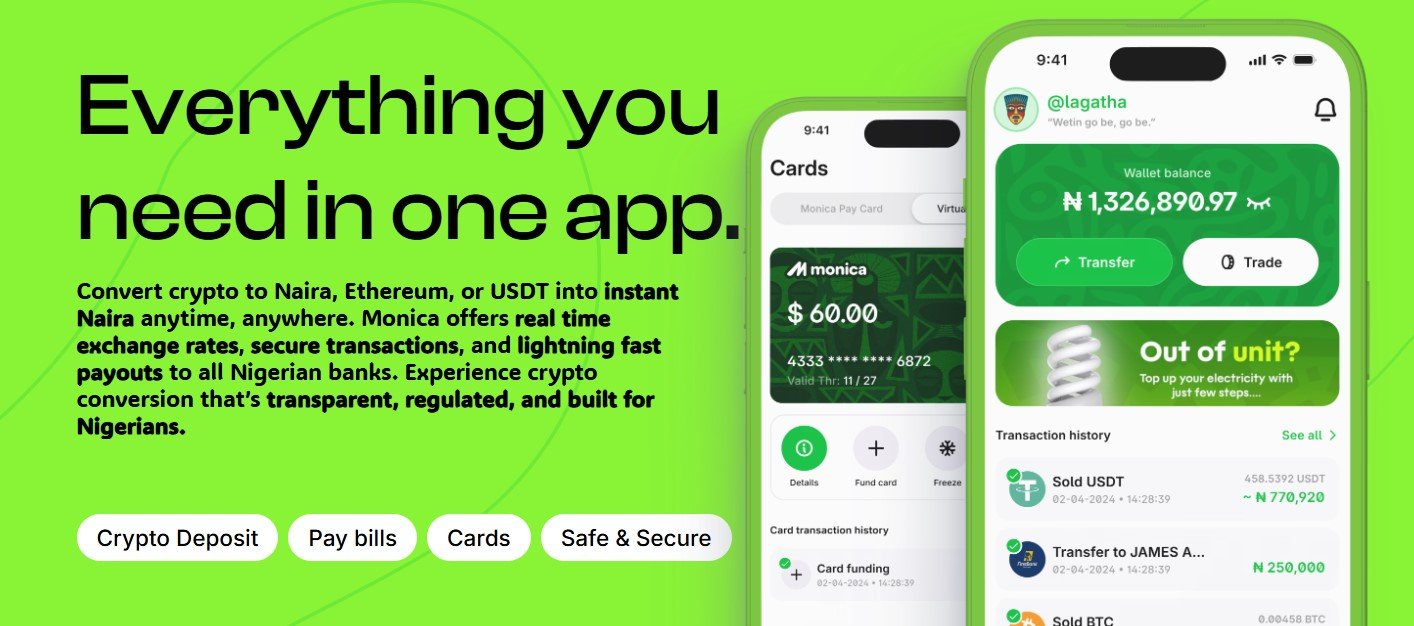
Are these apps safe? Safer than many alternatives, but only if you choose wisely. Solid platforms (for example, Monica.cash) usually offer:
- fixed‑rate windows so the rate doesn’t jump mid‑transaction
- clear fees with no hidden spread
- support for reliable networks (TRC20/ERC20)
- fast payout channels (bank, mobile money)
- reasonable limits per transaction
- visible licensing/KYC info
- active customer support you can actually reach
A good rule: if an app looks like it was designed overnight, promises “unusual bonuses,” or hides its fees — walk away.
Is this useful for businesses? Absolutely. Freelancers use it to avoid losing money to international fees. Online sellers rely on it to accept global payments. Small teams pay staff the same day they get paid. Agencies handle cross‑border invoices without wrestling with outdated banking rails.
If your work touches global clients in any way, off‑ramps turn a painful process into a predictable one.
